Explore checkers, demos and evaluation routes →
How device fingerprinting works: attributes, identity and risk
Separate attributes, fingerprints and recognition
Browser attributes are observations; a fingerprint summarizes some of them; recognition compares observations over time. Canvas pixel output, Web Audio processing, environment settings and transport evidence supply different surfaces. MDN notes privacy-related canvas noise, and W3C discusses identification and privacy impacts. A unique hash does not prove persistent identity. Store collector version and missing surfaces to understand drift and changes.
Specify what an audio SDK measures
OfflineAudioContext renders a generated graph to an AudioBuffer rather than directly to speakers. Browser audio fingerprinting can summarize that processing output. Recording identification compares media content; microphone capture uses getUserMedia and its permission model. These are different products despite similar names. Similar audio results can support environment matching, but cannot identify a person, recording or telephone caller without the relevant separate system.
Evaluate providers on false merges, splits and missing data
Fingerprint, ShieldLabs, Castle and Incognia offer different recognition and risk combinations; ThumbmarkJS provides an inspectable fingerprinting approach. Confirm supported JavaScript and native SDK surfaces, server matching and account association. Use known same-device and different-device labels, with observation windows. Regional availability and data terms need direct confirmation. Signal count and a headline accuracy figure cannot establish the best provider for every CIAM or commerce stack.
Reference: Fingerprint: Smart Signals reference.
Compare recognition and integrity across web and native apps
Device intelligence may combine continuity with automation, tampering and location evidence. Native iOS/Android collectors differ from browser scripts. Incognia emphasizes location-grounded recognition; ShieldLabs combines network/device signals and account events. Verify supported fields and missing-result behavior separately on each surface. Owned-asset inventory is another category: discovering corporate equipment does not establish anonymous website visitor identity.
Reference: W3C: fingerprinting guidance.
Distinguish manipulated attributes from ordinary variation
Anti-detect detection looks for inconsistent or modified environments, while headless detection addresses automation. Privacy defenses can also alter properties. Combine evidence across surfaces and retain the reason used in a decision. A single unusual hash cannot prove abuse. Use authorized test environments and documented integrations when debugging; selecting tools to evade another platform's protection is a separate intent.
Reference: W3C: fingerprinting guidance.
Locate transport collection correctly
FoxIO's JA4 family includes TLS JA4, HTTP JA4H and TCP JA4T, with implementation tools in its repository. HTTP/2 observations concern another layer. Intermediaries affect what an origin sees, and Cloudflare documents missing JA3/JA4 results and plan limits. Many clients share transport fingerprints. They can group software behavior without becoming unique physical-device IDs or authentication credentials.
Explain why one person can look new again
Analytics deduplicates using its available identity. GA4 documents User-ID, device ID and modeling; a device change without a shared User-ID can create a new observed identity. Sessions and page views count different activity. Returning means earlier activity under the report's definition and period. Compare consistent cohorts instead of choosing a universal visitor ratio or blaming every change on failed fingerprinting.
Reference: Google Analytics: understand user metrics.
Keep personalization consequences proportionate
Anonymous first-party context can support language, recent items or general onboarding. Private addresses, billing and entitlement require authorization. Link the anonymous session to a known account through a trustworthy event, and label inferences separately from supplied facts. A probable device match should not reveal another user's information. Keep access checks on the server rather than granting privileges from recognition alone.
Reference: OWASP: authorization.
Worked example: Two error types point in opposite directions
Hypothetical example: one browser update produces a second identifier, while two unrelated environments receive one identifier. The first is a split, the second a merge. Label each separately using known cases and keep missing collection distinct. A single aggregate accuracy percentage can hide the consequences for account review and customer experience.
| Outcome | Definition | Expected label |
|---|---|---|
| False split | One expected relationship divided | Known same environment |
| False merge | Unrelated environments joined | Known different environments |
| Missing result | No usable observation | Collection status |
Continue with Device context in network and bot controls for the next evidence layer.
Separate owned-asset discovery from visitor intelligence
Device discovery and customer device recognition should have separate shortlist rows. Axonius manages active OT/IoT scanning adapters and scan jobs; Lansweeper describes IT/OT/cloud/IoT discovery and normalization. They answer inventory questions about owned assets. A browser-risk collector observes visits instead. Local digital intelligence remains broad until the buyer identifies whether the need is internal inventory, an authorized investigation or customer-facing risk and specifies the deployment requirement.
Sources
- W3C: mitigating browser fingerprinting · read
- MDN: CanvasRenderingContext2D.getImageData · read
- W3C: Web Audio specification · read
- MDN: OfflineAudioContext · read
- W3C: Web Audio privacy and security · read
- MDN: getUserMedia · read
- Fingerprint: Smart Signals reference · read
- Thumbmark: product and integration scope · read
- Incognia: use cases · read
- NIST: identity-proofing scope · read
- OWASP: automated threats · read
- Cloudflare: JA3 and JA4 · read
- FoxIO: JA4+ project and specifications · read
- Cloudflare: HTTP headers · read
- NIST: authentication and sessions · read
- Google Analytics: user metrics · read
- Google Analytics: reporting identity · read
- Google Search Console: performance report · read
- Google Search Console: dimensions and query omissions · read
- OWASP: authorization · read
- Primary source: docs.axonius.com · read
- Primary source: www.lansweeper.com · read
- Primary source: deviceatlas.com · read
- Primary source: privacysandbox.google.com · read
- Primary source: shieldlabs.ai · read
- Primary source: www.incognia.com · read
- Primary source: acoustid.org · read
- Primary source: acoustid.org · read
- Primary source: cflib.org · read
- Primary source: castle.io · read
- Primary source: www.browserscan.net
Continue reading
FAQ
Is a collision the same as a false decline?
A collision is a recognition error. A false decline is a downstream rejection of a legitimate transaction and needs its own outcome evidence.
What does DeviceAtlas identify?
When describing a device, DeviceAtlas supplies device identification and properties for uses including optimization and analytics. Score that output separately from a persistent person identity or ready account-abuse finding. Verify the returned object rather than treating every device-intelligence product as the same recognition service.
What did the April 2025 Chrome tracking announcement say?
When describing a device, the dated Google announcement is useful context: on April 22, 2025 it retained Chrome's existing third-party-cookie choice approach instead of a standalone new prompt and described further tracking-protection work. It is a dated policy announcement, rather than a complete inventory of every Chrome feature shipped afterward.
Which recognition providers belong on a device shortlist?
For identification, compare hosted matching with the work a library leaves to the team. Compare Fingerprint for recognition and documented Smart Signals, ThumbmarkJS for an inspectable fingerprinting approach, ShieldLabs for recognition plus ready risk/account events and Incognia where location-grounded recognition is central. Match web/native surfaces, errors, retention and required output before choosing.
How do music or acoustic fingerprints differ from browser audio fingerprints?
For device teams comparing audio-related purchases, Chromaprint extracts a recording fingerprint from supplied audio; AcoustID can look it up with duration and return related recording metadata. A typical authorized workflow decodes the recording, generates the fingerprint and queries an appropriate catalog. Check corpus fit, permissions and commercial service terms. Browser Web Audio fingerprinting instead compares processing behavior; it does not identify the song, speaker or rightful account owner.
How should separate browser profiles be used for authorized account work?
For a device workflow, distinguish environment continuity from personhood and permission. First establish permission to operate each account. Use documented workspace roles, distinct session/storage profiles and the platform’s approved team or agency APIs where available. For testing your own application, record the profile, collector version, expected permissions and result, then verify that private data and grants remain isolated. A modified browser or rotating route does not create account eligibility or permission to evade another service’s restrictions. W3C fingerprinting guidance explains the observable surfaces; OWASP authorization applies independently of profile appearance.
How should device intelligence be selected for a Saudi deployment?
For a device workflow, distinguish environment continuity from personhood and permission. Build a shortlist around ShieldLabs, Fingerprint, Incognia or a broader risk supplier according to the required web/native and decision scope. Then request a written data-flow and contract review covering collection purpose, lawful transfer arrangements, processing/storage locations, subprocessors, retention/deletion, regional network latency and support. A product marketed worldwide does not by itself establish Saudi hosting or a local-residency commitment. Make those acceptance conditions explicit before purchase.
What should a browser-detection or browser-scan result be used for?
For a device workflow, distinguish environment continuity from personhood and permission. Clarify whether the task is parsing browser software, inspecting the current environment, classifying a relay or recognizing repeat activity. The CFLib browserDetect function, dated 2011, illustrates user-agent parsing rather than persistent identity. A scan can report selected browser/network observations without proving account ownership or universal anonymity. If a search phrase is an imprecise spelling of anti-detect or a legacy tool name, confirm the exact maintained product and official documentation before downloading or choosing infrastructure. An anonymizing gateway routes traffic through another endpoint; it does not erase the site’s other history. These category distinctions interpret the task without asserting that every ambiguous string names a verified product.
Which visitor/device options fit identity platforms and gaming?
For a device workflow, distinguish environment continuity from personhood and permission. For CIAM or gaming, compare Fingerprint for recognition/Smart Signals, ShieldLabs for recognition plus ready abuse events, Castle for account/environment intelligence and Incognia where location-grounded recognition matters. Include legitimate shared equipment, updates, cookie resets, platform-supported native/web clients and repeated restricted claims. Measure recognition errors and player completion separately from policy findings. Favor the documented output that fits your flow rather than an unverified universal reliability label.
If BrowserScan is intended, what does its browser check show?
The BrowserScan page lists network, browser, canvas/audio and automation diagnostics. Treat “scanbrowser” as an imprecise service name until the intended URL is confirmed. A generic browser scan can also mean inspecting observable properties. Diagnostic output describes what the checker sees in that context; it is not a certificate of population uniqueness, account ownership or invisibility to every website.
Summarize this page with
Device fingerprinting recognizes a browser or device by combining observable attributes with a matching process. A useful implementation returns a reusable identifier and enough context to understand the observation. It does not turn a browser into a verified human identity, and the number of collected attributes does not establish how well recognition works over time.
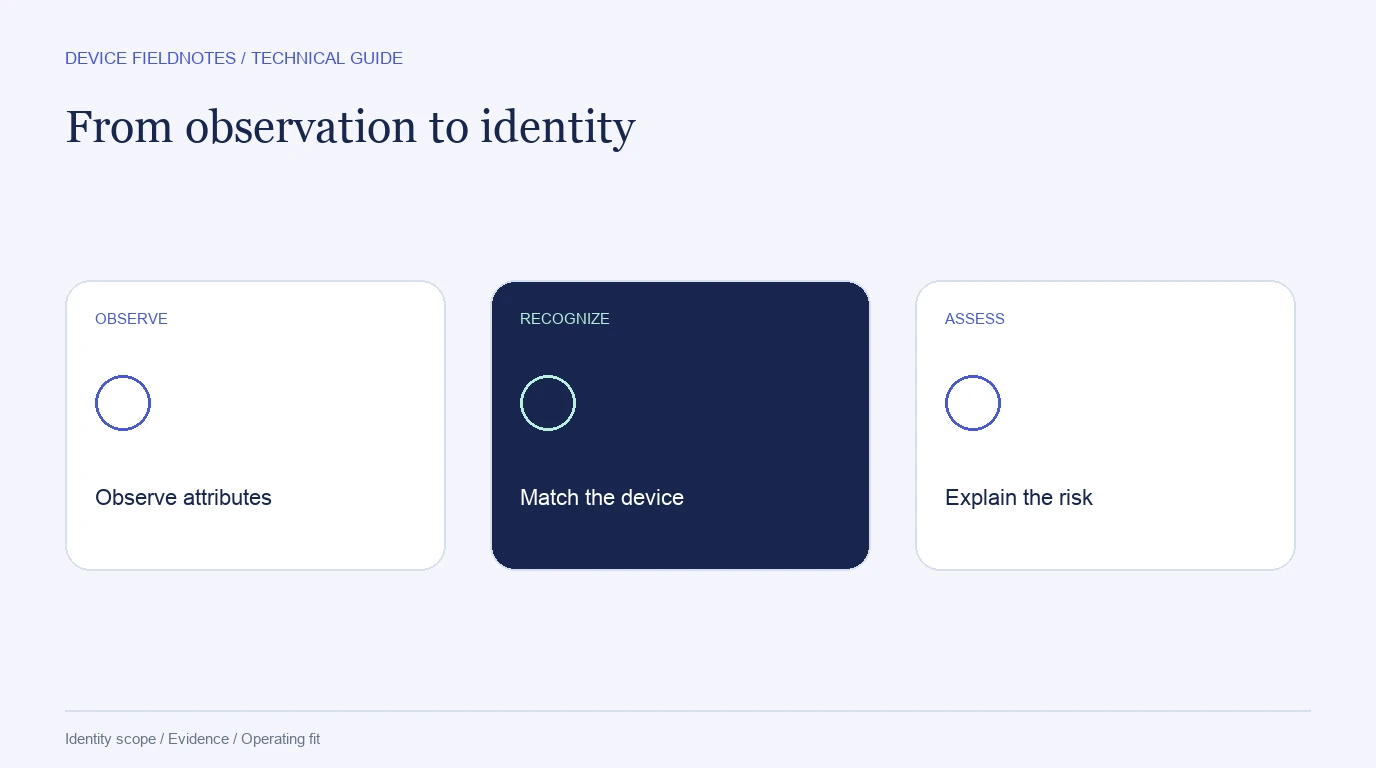
- 1Observe attributes
- 2Match the device
- 3Explain the risk
Start with the entity you want to recognize
A session is one period of activity. A cookie is stored browser state. A device fingerprint is an inference from available device and browser evidence. An authenticated account is an application record. These entities often move together, but a customer can use multiple devices and several people can use one shared computer.
Write down the identity unit before selecting a product. For login protection, the question may be whether a known account is using a familiar device. For promotion abuse, it may be whether linked device activity connects several accounts making repeated claims. For anonymous traffic quality, a reusable device reference may provide continuity before a person signs in. Each use case needs more than a count of unique strings.
What can contribute to a fingerprint?
Browser-visible evidence can include rendering behavior, fonts, screen configuration, language, platform capabilities and other environment attributes. Canvas, WebGL and audio processing are different collection surfaces rather than interchangeable names for one identifier. The available signals depend on browser and platform behavior, and a server can add network observations and consistency checks.
The W3C fingerprinting guidance treats fingerprinting as a privacy concern for web specifications. That is a reason to document collection purpose and minimize unnecessary data, not a guarantee that a given technique is either permanent or unavailable in every browser.
| Evidence | What it can contribute | What it cannot establish alone |
|---|---|---|
| Rendering and environment attributes | Similarity between observations | The real identity of the person using the browser |
| Cookie or first-party state | Continuity within stored browser state | Recognition after that state has been removed |
| Network observations | Connection context and inconsistencies | A permanent device identity from an IP address |
| Account association | Which known account performed an action | That every account on one device belongs to one person |
| Outcome history | Whether earlier activity was confirmed abusive | Whether every future action from that device is fraudulent |
Canvas, WebGL and audio are input surfaces
Canvas can expose differences in how a browser renders a requested image or text. WebGL can add graphics-stack and rendering context. An audio-processing graph can expose small environment-dependent differences in its output. These are browser-observable measurements, not a microphone recording or a voiceprint. Each can change with software or privacy behavior.
Treat these inputs as parts of a matching system, not independent guarantees that a device is unique. A robust evaluation asks whether the combination remains useful across ordinary updates and whether similar managed devices stay separate. Unqualified audio-fingerprinting searches often concern music recognition, which is a different task from browser audio evidence.
Hashing and matching solve different problems
A hash deterministically converts input into a value. If the input changes, the value can change. A matching system may normalize attributes, compare observations over time and combine more evidence than a client-side hash. That gives it a different job: preserve useful continuity while avoiding matches between unrelated devices.
The FingerprintJS repository documents the client-side library and its scope. The hosted commercial product has a separate architecture and access model. Evaluating the library does not validate the hosted service, and a hosted service's advertised accuracy does not describe a self-hosted hash.
An identifier and a risk verdict answer different questions
An identifier asks whether observations belong to the same device or browser under the product's matching scope. Risk asks what the current evidence means for an action. A familiar device can perform a risky transaction; an unfamiliar device can belong to a legitimate returning customer. A useful fraud integration keeps both facts.
ShieldLabs Device Intelligence combines Device ID with current device/network signals and ready-made account-level abuse detections. Its risk score and Trusted, Suspicious or Dangerous outcomes add context for visitors, users, devices and IPs. This is useful when the job includes repeat abuse and masked traffic rather than recognition alone. See the full ShieldLabs review and alternatives by product shape.
A practical example: anonymous visit to signup
Imagine a person who reads a pricing page, changes network and later signs up. The application may have a session reference, a device reference and then an account reference. Preserve the references used for each event instead of overwriting them with the account ID. That lets a reviewer inspect continuity and risk at the time of the action.
Now imagine another person using the same shared computer. Device similarity may be expected, yet the accounts must remain distinct. This is why a claim about device uniqueness cannot replace an evaluation of false merges and shared-device behavior. Use the accuracy guide to define ground truth and the integration guide to keep collection and trusted retrieval connected.
FAQ
Is browser fingerprinting the same as device fingerprinting?
The terms overlap in vendor language. Inspect the defined matching scope: browser profile, device/browser combination, native app installation or another entity. Do not assume that the word device promises recognition across every browser and app.
Does a fingerprint require a login?
A product can return an identifier for an anonymous visit. A later authenticated account association is a separate step and should be supplied through the supported integration.
Does collecting more signals guarantee better recognition?
No. Signal stability, spoofing resistance, matching behavior and collision handling matter. Compare known-device outcomes and false merges, not only signal counts.
Sources
Sources reviewed October 23, 2026.
Continue reading
- Device ID persistence after cleared cookies, incognito and IP changes
- Integrate device fingerprinting into signup, login and checkout
- Web vs mobile device fingerprinting: choose the right integration
Compare all eleven tools or read the complete deployment guide.