Device context in network and bot controls
Use browser continuity with trusted network inputs, automation evidence and challenge validation.
Summarize with AI
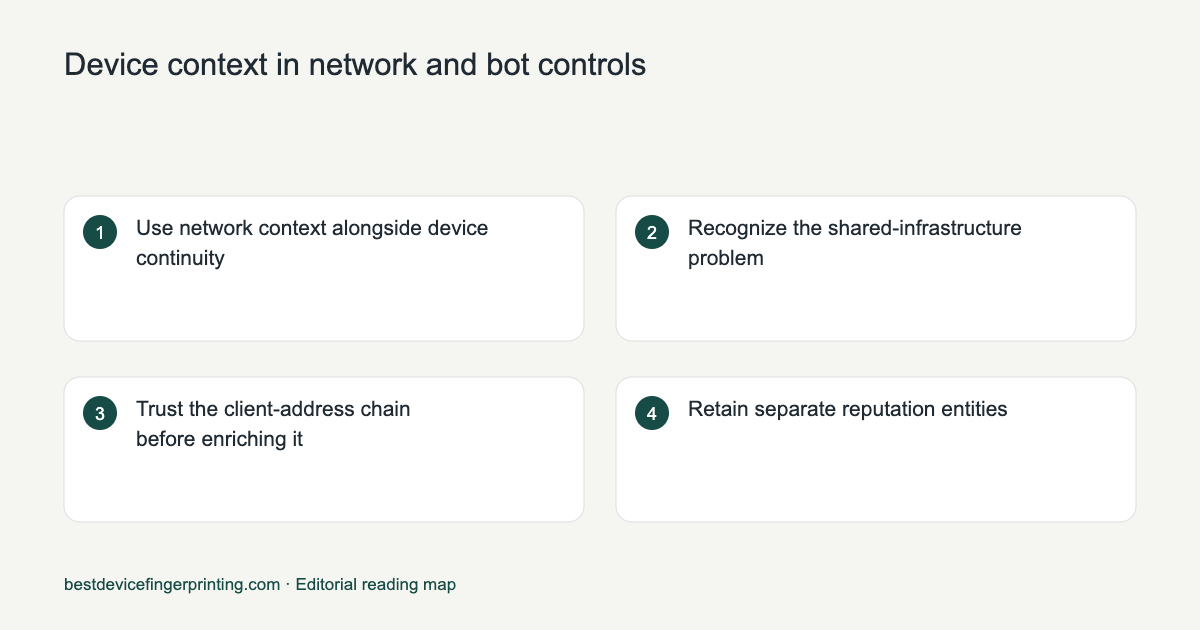
Use network context alongside device continuity
IPQualityScore and MaxMind provide network intelligence; ShieldLabs, Castle and Maskbreak combine relevant masking checks with broader evidence. Compare VPN, Tor, hosting, residential and mobile categories and purchased-plan coverage. A stable device can appear through many exits, while many users can share one address. Preserve reason and freshness, then evaluate the action with legitimate privacy and corporate-network cases.
Reference: IPQualityScore: product families.
Recognize the shared-infrastructure problem
Residential or mobile network ownership does not prove either ordinary use or proxying. Selected MaxMind products provide provider, confidence and last-seen context. Join those observations to device and account activity across rotation. Include carrier NAT and Private Relay in legitimate controls. A correct proxy label can still produce an unjustified restriction, so classification and policy outcomes need separate denominators.
Reference: MaxMind: anonymizer and proxy data.
Trust the client-address chain before enriching it
Use known ingress infrastructure to establish the client address, rather than accepting arbitrary forwarding headers. Confirm IPv6 and necessary categories, timestamps and errors in the API contract. Apple publishes Private Relay feeds that should be interpreted separately. An IP-only lookup cannot collect rendering or browser-integrity evidence. Budget repeated lookups and caching against the required freshness and the vendor's actual unit.
Reference: Cloudflare: HTTP headers.
Retain separate reputation entities
IP reputation concerns network evidence; device reputation concerns the observed environment and related activity. Keep provider scales, reasons and observation time intact. Inspect IPQS or other outputs on the purchased plan and calibrate the action to labeled outcomes. A clean address cannot authenticate a person, and a high-risk shared address should not erase a trustworthy account's history without further review.
Reference: MaxMind: proxy and anonymizer data.
Keep geography and its uncertainty visible
A network can locate an exit rather than the device. Browser geolocation includes an accuracy value and requires the appropriate access. Compare timestamps, device continuity and account activity before concluding spoofing or impossible travel. Travelers, relays and mobile handoffs can create benign disagreement. Exact-looking coordinates do not establish exact physical presence or automatically satisfy a jurisdiction-specific compliance requirement.
Reference: MDN: geolocation accuracy.
Understand what a public checker can observe
An anonymity checker reports selected browser and network properties from its own context. It cannot certify universal invisibility or show every application's private history. Record expected settings before comparing a controlled environment change. Use the diagnostic to answer a specific visibility question. A clean result neither authenticates a person nor proves that all sites will fail to recognize the browser.
Reference: W3C: mitigating browser fingerprinting in web specifications.
Separate device recognition from bot mitigation
A device identifier supports continuity; a bot engine evaluates automation and may enforce access. Cloudflare provides request scoring, HUMAN spans advertising and application protection, and Arkose combines fraud prevention with agent controls. Define which output your stack lacks. Evaluate collection coverage and legitimate completion alongside automation detected. Identifying a botnet's infrastructure needs a separate network-security product rather than another browser identifier.
Reference: Cloudflare: bot scores.
Connect collection to the protected action
A reliable integration obtains supported client evidence, associates it with the action and retrieves a trusted server result. Keep secret credentials server-side and do not accept the browser's own verdict. Turnstile needs Siteverify validation with five-minute, single-use tokens. A WordPress plugin still needs backend protection. Record collection errors, timeouts and repeated submissions as distinct outcomes.
Reference: Cloudflare Turnstile: validate the token.
Model agent identity and user permission separately
AI agents can use ordinary browser environments and legitimate user accounts. Recognize the agent where possible, verify crawler claims through documented provider methods and define permitted endpoints. A fingerprint match does not establish delegated authority. Require appropriate authorization before an agent changes account state or spends value. Preserve agent and user references so support can explain which party initiated the action.
Reference: Google: verify crawler and fetcher requests.
Choose low-friction assurance deliberately
Passkeys authenticate, Turnstile evaluates a challenge, Private Access Tokens support privacy-preserving device/user legitimacy, and fingerprints estimate continuity. These outputs complement each other. Apple tokens do not prove entitlement to a particular account or benefit. Validate challenge results on the server and test owner completion across accessibility and privacy configurations. Avoid assigning an authentication guarantee to a recognition signal.
Reference: Apple: Private Access Tokens.
Use device history to support credential defenses
Credential stuffing reuses leaked pairs; password spraying applies a common password across accounts. OWASP recommends MFA and layered controls. Join failures, device continuity and successful follow-on access across changing networks. Protect recovery and password reset as well as login. A familiar device can inform risk but should not automatically override suspicious account behavior or authorize every sensitive operation.
Reference: OWASP: credential stuffing prevention.
Worked example: A private browser omits a collection surface
Hypothetical example: a privacy configuration changes canvas output or prevents a useful reading. Preserve collection status and method version, then use the documented fallback. A missing surface should not silently become a new verified identity or automatic fraud finding. Compare the result with the actual account action and legitimate completion.
| Layer | Record | Fallback question |
|---|---|---|
| Browser | Available surfaces | Supported missing-data handling |
| Network | Trusted client IP | Fresh category and error |
| Challenge | Validated token | Expiry/replay refresh |
Continue with Device links in account protection and platform policy for the next evidence layer.
Sources
- IPQualityScore: product families · read
- Maskbreak: live-visit checks and IP lookup · read
- MaxMind: anonymizer and proxy data · read
- Apple: prepare for Private Relay · read
- Cloudflare: HTTP request headers · read
- OWASP: REST security · read
- OWASP: transaction authorization · read
- MDN: geolocation accuracy · read
- OWASP: authentication · read
- W3C: mitigating browser fingerprinting in web specifications · read
- MDN: OfflineAudioContext · read
- Cloudflare: bot scores · read
- OWASP: automated threats to web applications · read
- Cloudflare Turnstile: server-side validation · read
- HUMAN: application and advertising product families · read
- Arkose Labs: current platform scope · read
- Stripe: idempotent requests · read
- Google: verify crawler and fetcher requests · read
- OWASP: authorization guidance · read
- Apple: Private Access Tokens · read
- OWASP: credential stuffing prevention · read
- NIST: authentication and authenticator management · read
- OWASP: forgot password guidance · read
- Primary source: www.fraudfilter.io · read
- Primary source: www.fraudfilter.io · read
- Primary source: proxy6.net · read
- Primary source: oxylabs.io · read
- Primary source: brightdata.com · read
- Primary source: shieldlabs.ai · read
- Primary source: castle.io · read
- Primary source: www.hcaptcha.com · read
- Primary source: friendlycaptcha.com · read
- Primary source: altcha.org · read
- Primary source: prosopo.io · read
- Primary source: www.mtcaptcha.com · read
- Primary source: en.vaptcha.com · read
- Primary source: docs.cloud.google.com · read
- Primary source: help.sitechecker.pro · read
- Primary source: www.incognia.com · read
- Primary source: www.kasada.io · read
Continue reading
FAQ
Can a missing fingerprint be treated as fraud?
Missing evidence is an operational outcome. Define a proportionate fallback using the action, account history and available verification.
How long is FraudFilter’s trial?
Alongside browser collection, FraudFilter advertises a seven-day trial without a credit card. Its pricing page separately lists 199 US dollars per month and a fifteen-day refund policy. Keep trial duration and refund conditions distinct when comparing evaluation access.
What is the Proxy6 anonymity check?
Alongside browser collection, Proxy6 offers a public anonymity-check page for selected IP and browser observations. It is a diagnostic route rather than a certification of invisibility to every site. Review displayed scope and access separately from a production API contract.
Which tools fit IP enrichment versus broader bot or account risk?
For a device platform, keep network and automation evidence interpretable. IPQualityScore and MaxMind are relevant for IP intelligence. ShieldLabs or Castle add broader environment/account context. For request-level bot enforcement, compare Cloudflare, HUMAN and Arkose against the required routes and response integration.
Which seven CAPTCHA-related brands are relevant to compare?
A source-backed shortlist is Cloudflare Turnstile, hCaptcha, Friendly Captcha, ALTCHA, Prosopo, MTCaptcha and Arkose Labs. For a device platform, keep network and automation evidence interpretable. Compare server validation, accessibility, supported surfaces and data handling. Broader vendors can include account or agent features beyond a challenge, so inspect the proposed product rather than assuming all plans are puzzle-only.
Can a residential VPN guarantee that a site will not recognize a visit?
For a device workflow, distinguish environment continuity from personhood and permission. Choose a privacy service for the stated privacy requirement and its published data practices, rather than a promise of undetectability. A residential-looking exit does not remove account history, browser evidence or other observations available to a site. MaxMind explains how anonymizer intelligence concerns the exit. For a legitimate access problem, use the site’s supported authentication or support route. For your own system, evaluate privacy connections with known permission and expected results.
How should VAPTCHA be compared with reCAPTCHA?
For a device workflow, distinguish environment continuity from personhood and permission. Compare the verification flow and backend integration rather than assuming “better” has one universal meaning. VAPTCHA’s FAQ distinguishes redirected SV verification from onsite EV verification and requires server confirmation. Google’s website assessment guide describes the reCAPTCHA backend assessment and token validity checks. Evaluate supported surfaces, accessible recovery, privacy/data handling, completion and replay behavior on your own authorized flow. The malformed comparison wording is interpreted here as a product-selection question, not a verified performance claim.
What is Sitecheckerbot?
For a device workflow, distinguish environment continuity from personhood and permission. Sitechecker’s crawler documentation identifies SiteCheckerBotCrawler as its website-audit crawler and provides a current IP-list route. Audit crawling and fraud detection are different tasks. If you operate the site, manage intended crawl access through the documented robots/WAF configuration and verify the request source rather than trusting its user-agent alone. Seeing the name in a log does not establish that the visit is a harmful account bot.
Which options fit mobile-proxy and high-volume risk checks?
For a device workflow, distinguish environment continuity from personhood and permission. For network enrichment, compare IPQualityScore and MaxMind. For additional device/account context, compare ShieldLabs, Castle and Incognia according to the required mobile/location surface. Specify expected peak requests, concurrency, IPv6 mix, freshness, latency distribution, rate limits and outage handling in a written offer. Use known legitimate proxy/relay users and confirmed abuse to choose proportional responses. A high-volume statement or proxy label cannot guarantee zero disruption to ordinary customers.
What should a mid-size ecommerce team evaluate when replacing Cloudflare bot controls?
For edge/application bot protection, compare Kasada, HUMAN and Arkose against the checkout, search, signup and login routes you use. Add ShieldLabs or Castle when account/device context is also missing. Inventory the current edge rules, trusted client-IP chain, challenge verification and permitted crawlers. Pilot the replacement on the same legitimate and abusive event populations, preserve a rollback path and confirm which provider owns each response. A migration should preserve required controls rather than replace a CDN name with an unrelated lookup API.