Explore checkers, demos and evaluation routes →
Summarize this page with
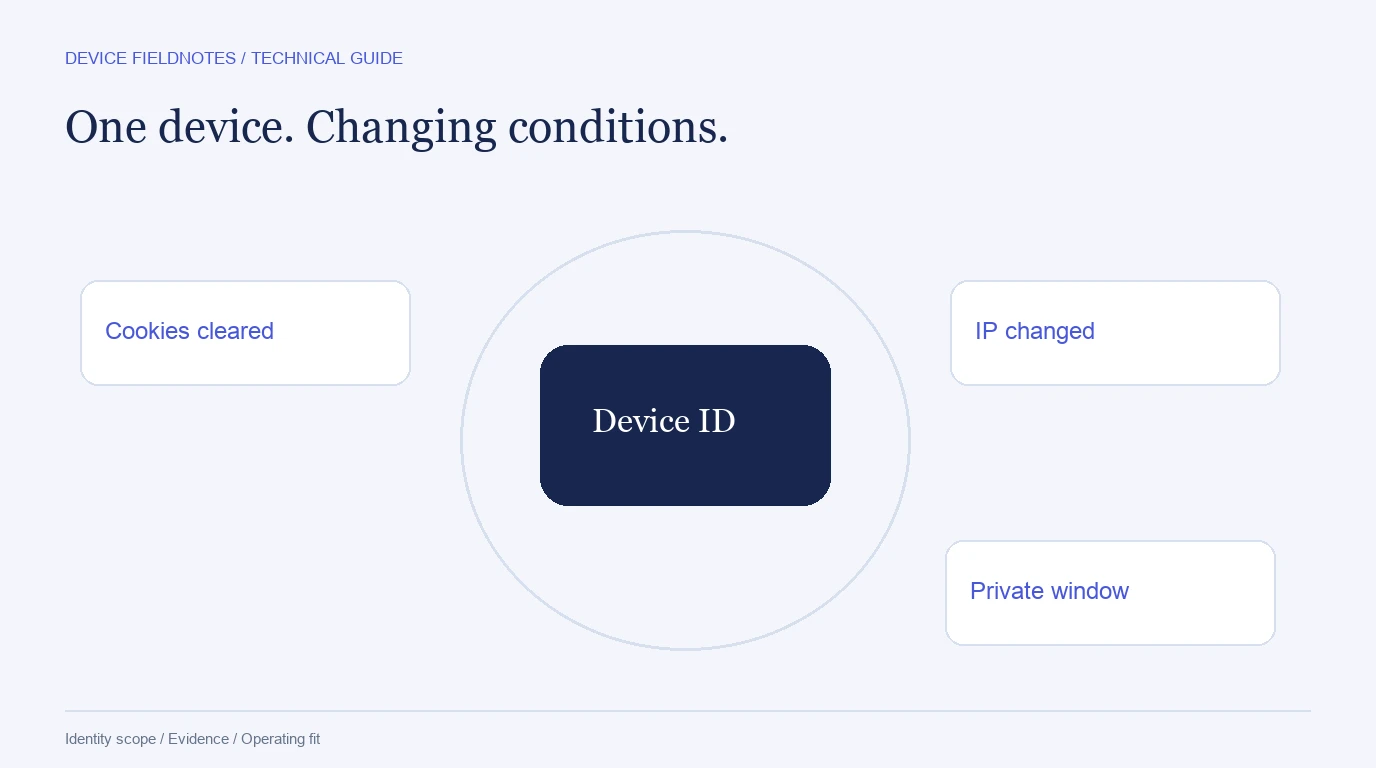
A device fingerprint can support continuity after cookies are cleared or an IP address changes, but the result depends on the product, browser and available evidence. Evaluate persistence as a set of specific changes. A cookie reset, an incognito window, an operating-system update and a second browser are different tests.
- 1Keep ground truth
- 2Change one condition
- 3Inspect continuity
Why cookies and device identifiers diverge
A cookie is an explicit stored token. When it is removed, the application may receive a new cookie identifier even though the hardware has not changed. A fingerprint-based Device ID can use other evidence to connect returning observations. The cookie and device counts can therefore differ for legitimate reasons.
Do not force the application to use one number for every question. Sessions describe activity windows; visitors describe the product's visitor scope; devices describe its matching scope; accounts describe authenticated identities. Your analytics and fraud tools may use different units. Compare their definitions before treating a disagreement as a detection failure.
Change one condition at a time
Use a known test device and an independent test label. Keep the account, browser version and observation schedule fixed while changing one condition. Record both the old and returned references. Only after the individual cases are understood should you combine cookie removal, network rotation and browser changes.
| Test | Hold constant | Change | Inspect |
|---|---|---|---|
| Storage reset | Known device and browser | Cookies and local storage | New cookie reference versus device continuity |
| Private window | Known device and browser family | Browsing context | Matching scope and missing evidence |
| IP rotation | Known device/browser state | Authorized network exit | Whether the IP is incorrectly treated as identity |
| Browser update | Known physical test device | Browser version | Drift in attributes and matching outcome |
| Different browser | Known physical test device | Browser family/profile | Whether cross-browser recognition is actually supported |
| Shared computer | Physical device | Authorized test user | Account separation and legitimate device reuse |
Private browsing is not a standardized promise of either universal invisibility or universal persistence. Browser vendors limit different data and storage surfaces. The W3C guidance discusses the privacy problem; the tool's documentation must define its own recognition scope.
How ShieldLabs separates the references
ShieldLabs describes Device ID continuity across sessions, cleared cookies and IP changes, alongside separate device, visitor, cookie and session context. Its device evidence can link visits even when the cookie reference changes. The current product page lists 99.9 percent identification accuracy; compare the stated figure using your own known-device conditions and required surfaces.
Keep the account identifier separate from Device ID. One customer can have a phone and a laptop, and several customers can use one kiosk. A new device is useful context for a login, but it should not silently turn into a new person. Read the ShieldLabs review for identity, risk and ready-made account findings.
Detecting repeated activity through changing exits
Suppose a controlled test group performs repeated signup actions while changing authorized proxy exits. Store the event's device, visitor, account and network references, plus the current risk evidence. Count the account actions and device relationships independently of IP churn. Otherwise rotating addresses can inflate the apparent number of new users.
A device relationship alone is not a confirmed abuse label. Shared households, support staff and test environments can also produce repeated associations. Put those legitimate patterns into the test set and inspect the response around the protected action. The evaluation article explains how to measure both continuity and false matches.
Missing collection is a separate outcome
A blocked script, unavailable SDK or late response can prevent assessment. Record that as unavailable evidence rather than inventing a clean result or assuming a new identity. For known customers, define how the application handles the missing result before enabling restrictions. Review collection availability by browser and platform, because one overall success rate can hide a weak segment.
When privacy settings change frequently, rerun the same controlled cases after product or browser updates. Store the integration version and observation dates so a result can be reproduced. This is more useful than a permanent promise that an identifier will never change.
FAQ
Will clearing cookies always create a new Device ID?
No. A fingerprinting product may recognize a device using evidence beyond stored cookies. Test the product's Device ID separately from its cookie or visitor reference.
Is cross-browser recognition guaranteed?
No. Confirm the documented matching scope and evaluate different browser families separately. A device-level label does not automatically promise a shared identity across every app and browser.
Can a stable ID prove who a person is?
No. Device continuity helps associate observations. Authentication and person-level identity are separate processes, especially on shared hardware.
Sources
Sources reviewed October 23, 2026.
Continue reading
- How device fingerprinting works: attributes, identity and risk
- Measure device fingerprint accuracy: recall, collisions and drift
- Device fingerprinting cost: free tools, API plans and total ownership
Compare all eleven tools or read the complete deployment guide.