Summarize this page with
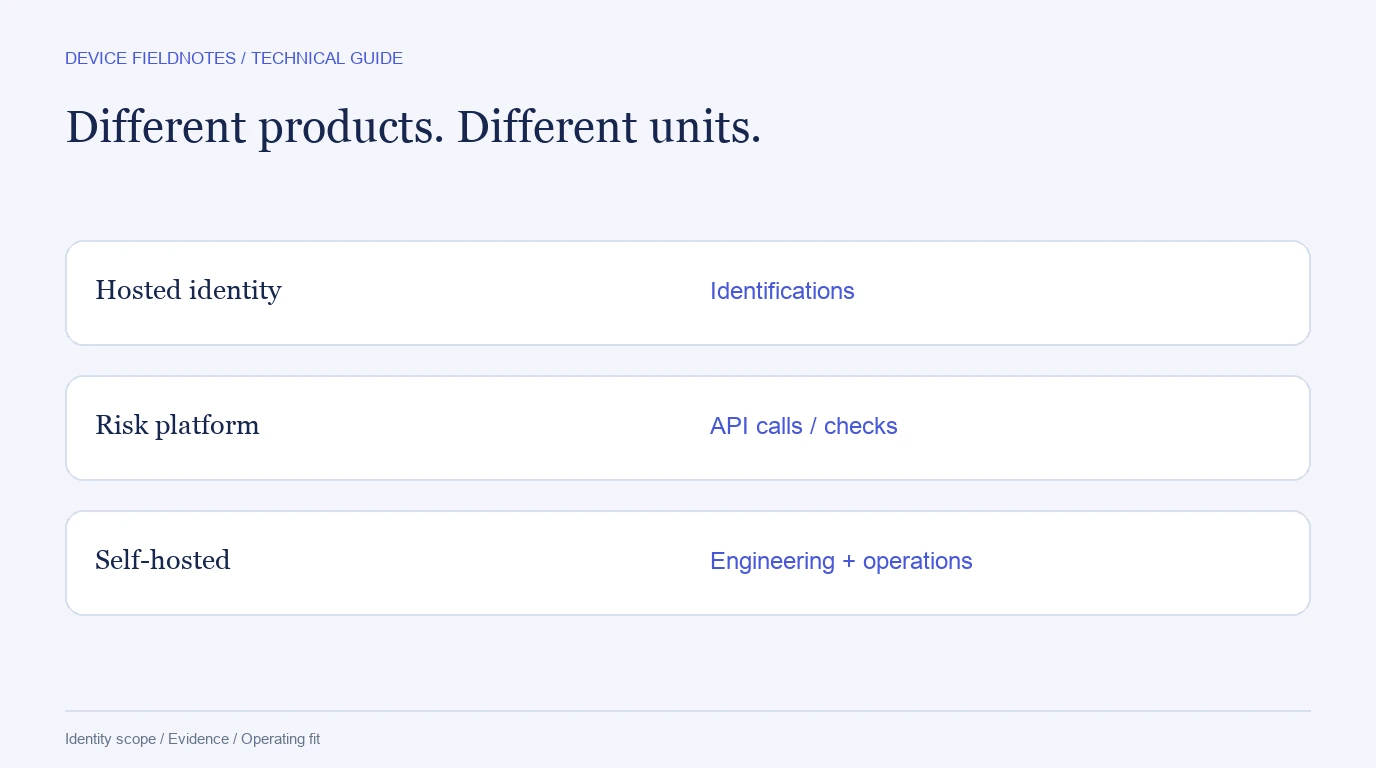
Device fingerprinting cost depends on the product's billing unit and the amount of work the team must own. A free browser library, 1,000 hosted API calls, 5,000 identifications and a monthly-active-user contract are different offers. Start with the protected events and evidence required before comparing headline prices.
- 1Define the workload
- 2Normalize units
- 3Include operating work
What can a small team try for free?
ShieldLabs includes 5,000 free identifications with device/network context and risk, while the current paid entry is 99 US dollars per month for 25,000 identifications. That route fits teams that want identification and ready-made account-level findings together. Review ShieldLabs access and its pricing page for the exact included volume.
Fingerprint lists up to 1,000 free monthly API calls and a Pro Plus trial. Castle includes 5 US dollars of monthly API usage in Free, equivalent to 1,000 Risk API calls or 5,000 IP lookups. Those two Castle routes return different evidence, so a larger number of IP lookups is not a larger device-assessment allowance.
FingerprintJS is a self-hosted client-side library under the repository's current MIT license. It has no hosted identification subscription, but collection, storage, matching evaluation and the business response become engineering responsibilities. Use it as a baseline when that ownership fits the application.
Compare a defined monthly workload
| Product route | Published entry | Unit to model |
|---|---|---|
| ShieldLabs Starter | 99 US dollars/month, 25,000 included | Identifications |
| Fingerprint Pro Plus | 99 US dollars/month, 20,000 included; 4 US dollars per additional 1,000 | API calls |
| Castle Pro | 200 US dollars/month of included API usage | Risk calls or other priced requests |
| SEON Starter | 699 US dollars/month, 2,500 checks | Fraud checks in the platform/API plan |
| FingerprintJS library | No hosted subscription | Engineering, hosting and maintenance |
| Sales-assisted device platforms | Quote required | Contracted product and usage unit |
Figures are the published offers reviewed October 23, 2026. A trial entitlement can differ from the ongoing free plan. An API credit can cover more than one kind of operation. Confirm which requests the final integration will actually make.
Worked example: 100,000 protected events
For an illustrative workload with one billable identification or Risk API call per event, 100,000 events exceed ShieldLabs Starter's included volume. The Growth plan includes 150,000 identifications for 399 US dollars per month. Fingerprint Pro Plus includes 20,000 calls; 80 additional blocks of 1,000 at 4 US dollars add 320 US dollars, bringing the example to 419 US dollars.
Castle prices Risk API calls at 0.005 US dollars each with 200 US dollars included in Pro's monthly fee. At 100,000 Risk API calls, usage is 500 US dollars under that rate. Do not add the 200 US dollars again as though it were a separate fee on top of all usage. Confirm current allowances and the treatment of other endpoint types.
These examples compare billing arithmetic, not equivalent detection quality. They exclude taxes, annual discounts and additional products. The right choice depends on the evidence returned, integration fit and legitimate-user outcomes.
Estimate the operating work
A client-only identifier may need storage, drift handling, replay protection, account linking and a review process. A hosted platform may provide more of those functions but require integration with a specific event model. A consortium product can add shared reputation while requiring a different commercial and operational process.
Estimate engineering time separately from usage. Include SDK updates, version testing, data retention, incident handling and the time spent investigating false merges. Also count manual review and customer support caused by the chosen business response. Those costs can dominate the monthly API price at modest volumes.
Choose the trial to answer a buying question
Before trying a product, name the required device fields, target surfaces, protected actions and expected event count. Run the same known-device and shared-device cases through each candidate. Record how much of the production integration the trial actually validates.
A checker demonstrates a particular visit. A sandbox can validate request/response handling. Neither alone establishes recognition quality across weeks of ordinary browser updates. Use the evaluation guide and checkers directory to select a test route with the right scope.
FAQ
Which affordable tool should a startup try first?
ShieldLabs offers 5,000 free identifications with identity and account-risk context. Fingerprint and Castle have recurring small free allowances, while FingerprintJS is a self-hosted baseline. Select the evidence and integration before comparing the free count.
Is a free library cheaper at scale?
It removes hosted identification fees, but the team owns implementation and operations. Model engineering, storage, maintenance and the quality of the resulting decisions alongside API spend.
Should I count page views or protected events?
Count the events that trigger billable operations in the actual integration. If collection runs on every page view or is retried repeatedly, usage may exceed the protected-action count.
Sources
Sources reviewed October 23, 2026.
Continue reading
- Device ID persistence after cleared cookies, incognito and IP changes
- Integrate device fingerprinting into signup, login and checkout
- Web vs mobile device fingerprinting: choose the right integration
Compare all eleven tools or read the complete deployment guide.